Announcing Typesec: authority you can't forget at the call site
Typesec is amazing
June 2026 — Typesec 0.11.0 "Burano"
So should we like republish? Updated! Mexico! Yeah! See? Indeed!
Most authorization systems answer a question — is this allowed? — and then trust every line of code after the check to remember the answer. The check and the privileged action drift apart. A new code path forgets the guard. A refactor moves the call. The audit log says "allowed" while the wrong thing happens.
Typesec is a type-safe security framework for Rust that closes that gap. It turns authority into a value the compiler tracks: a function that does something privileged demands a capability as an argument, and the only way to get one is to pass a policy check. Forgetting the guard becomes a type error, not a production incident.
The load-bearing idea
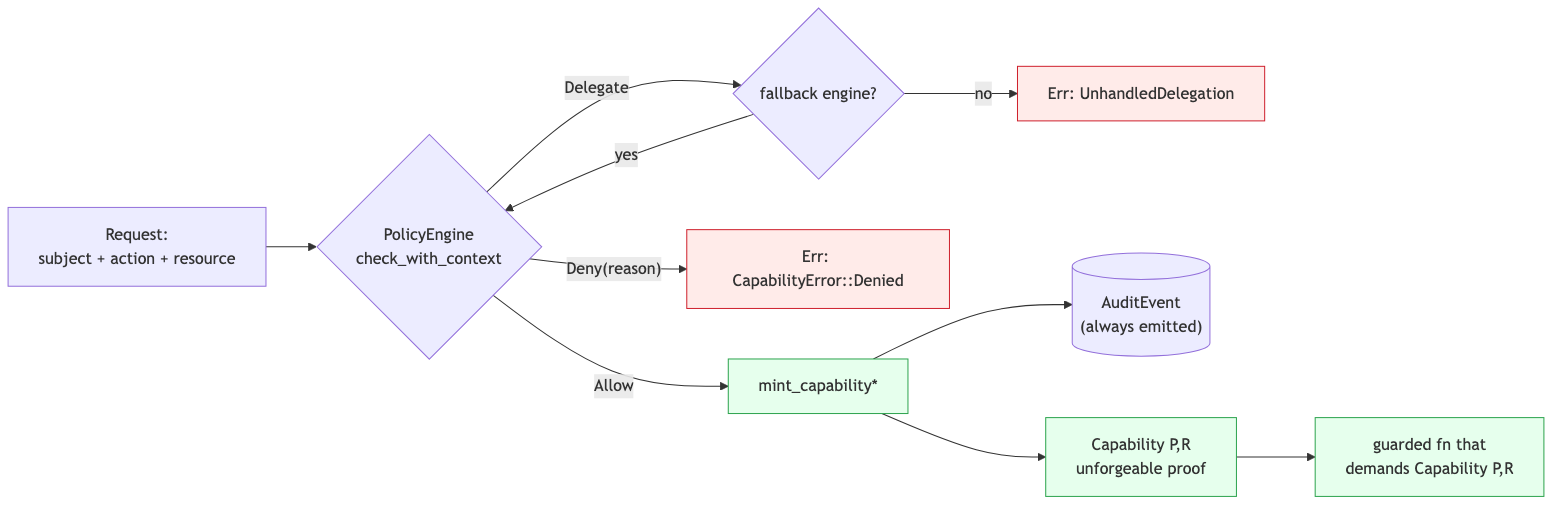
A Capability<P, R> is unforgeable proof that permission P was granted over resource R. It has no public constructor. The only way to mint one in production is mint_capability*, which runs a PolicyEngine, and — on success — emits an audit event. Permission, AgentState, and PrivacyLevel are sealed traits, and a suite of compile-fail tests stands guard so the boundary can't be bypassed even by accident.
The payoff: provider authorization isn't merely observed, it becomes a typed capability required by the handler. You cannot call the privileged path without proof, and the proof cannot exist without a policy decision and an audit trail.
What's inside
- One policy contract, many engines. Every engine implements the same checkwithcontext → Allow | Deny | Delegate interface: an RBAC engine (role inheritance + glob patterns), an ODRL engine (permission / prohibition / duty, constraints, full audit trail), and a graph engine that compiles policy into a typed graph with deny-overrides semantics.- Typestate agents. SecureAgent<S> and ProtectedTool push authorization into the type state of an agent, so a tool can only fire once the agent holds the capability it requires.- Integrations, not replacements. JWT/OIDC, WorkOS FGA, Arcade tool auth, and Pydantic AI all feed the same PolicyEngine boundary. Typesec sits under your existing OAuth stack and makes the local last mile impossible to skip.- DID / TypeDID messaging. Real cryptography (Ed25519 / X25519 / ChaCha20-Poly1305): agent-to-agent envelopes whose ciphertext is AEAD-bound to their routing and timing identity, with replay protection and audit-safe attestations that expose who did what to which resource without revealing the payload.- Typed privacy labels. SecureValue<L, T, R> classifies data at the type level, so a value's privacy level travels with it.- CLI + Python bindings. typesec validate / check / generate / run gives CI a policy gate with honest exit codes, and PyO3 bindings put the same checks in front of non-Rust agents.
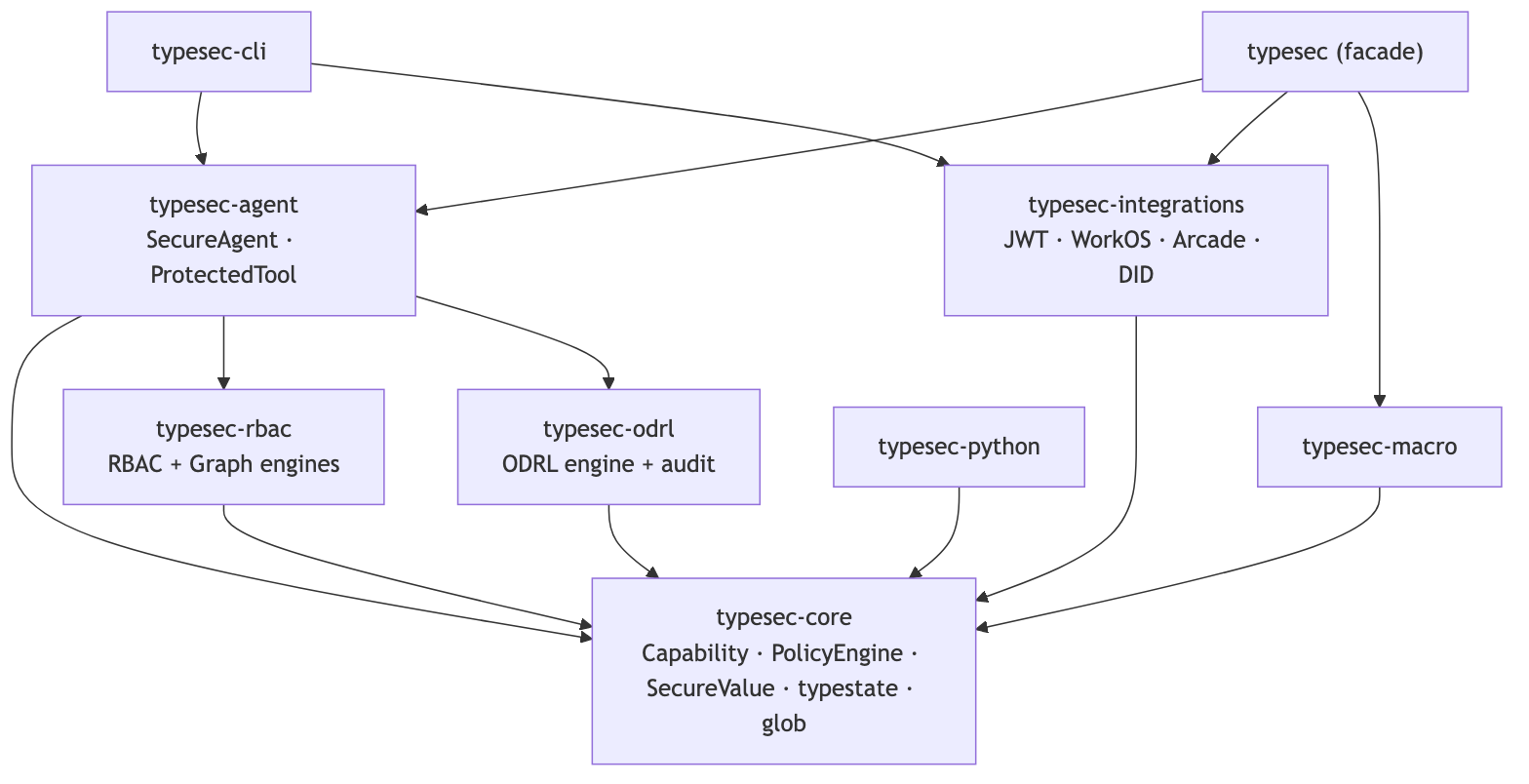
Nine crates, all layered on typesec-core, with the umbrella typesec crate re-exporting the rest behind feature flags:
Typesec in querygraph
Typesec and the Grust typed-graph engine ship from the same home, querygraph. Typesec's graph policy engine builds directly on Grust's typed graph: policies lower through Zod-validated schemas into a Grust graph, deny-overrides resolution decides the verdict, and grust-cypher can apply Cypher DDL constraints or run an authorized Cypher mutation through the same graph-store boundary. The result is graph-shaped authorization — roles, resources, and relationships as a typed graph — with the same unforgeable capability at the end of it. (Typesec 0.11.0 tracks Grust 0.11.0, "Crab.")
Typesec in lakecat
In lakecat, Typesec guards data-catalog resources — tables and datasets named like lakecat:table:events. A reader doesn't get the table by asking nicely; it gets a Capability minted against the catalog's policy, and the typed value it reads back carries its privacy label. When agents collaborate over that data, TypeDID envelopes carry an audit-safe attestation of the authorized action — subject, action, resource, privacy level, protocol — so the catalog has a verifiable record of every cross-agent access without ever exposing the payload or the signing material.
Try it
Typesec 0.11.0 is published on crates.io:
[dependencies]
typesec = { version = "0.11.0", features = ["integrations"] }
```- The book — the full design narrative, worked examples, and design tradeoffs: docs/book/typesec.md (also built as EPUB / PDF / MOBI under docs/book/dist/).- Where Typesec fits under OAuth/FGA stacks: docs/typesec-and-auth-frameworks.md.- Agent-to-agent messaging: docs/typedid-agent-communications.md, docs/did-messaging.md, and docs/typedid-ecosystem.md.- Graph policy end to end: docs/company-graph-grust-sail.md.- Provider integrations: docs/oauth-provider-integrations.md.
The check is the easy part. Typesec makes sure the line of code *after* the check can't forget what it said.